
Lift and Read Book Club, Issue 16
What's up, friends. Welcome to another Lift & Read Book Club Issue.
Let's get the lifting stuff out of the way. I've written about this already in the December Lifting Club, so I won't take up your time with all of it again on this page. Check this link from my blog for this month's training programs: https://www.30minutephysique.com/post/december-2025-lifting-club or you can check this link if you prefer reading on Substack: https://open.substack.com/pub/garagegymbro/p/december-2025-lifting-club?utm_source=share&utm_medium=android&r=4eypj7
-
Let's talk about the books!
As usual, we've got 3:
1 fiction
1 non-fiction/personal or business development
1 physical culture book
-
Okay, well, it's been a month since my last update, so I'm actually going to give you 2 fiction and 2 physical culture books.
Yippie-yah-yay.
So let's start with the fiction.
After "Banco" – which I finished before leaving Mexico a month ago – I immediately got to work reading "Tinker, Tailor, Soldier, Spy," which is a spy novel by John Le Carré. Le Carré is apparently the best of the best in the spy genre, and I like a good Cold War era spy story, so I was excited to read it. It was good enough for me to pick up one of his many other Spy novels.
As for my current fiction, I'm reading John Steinbeck's "The Winter of our Discontent."
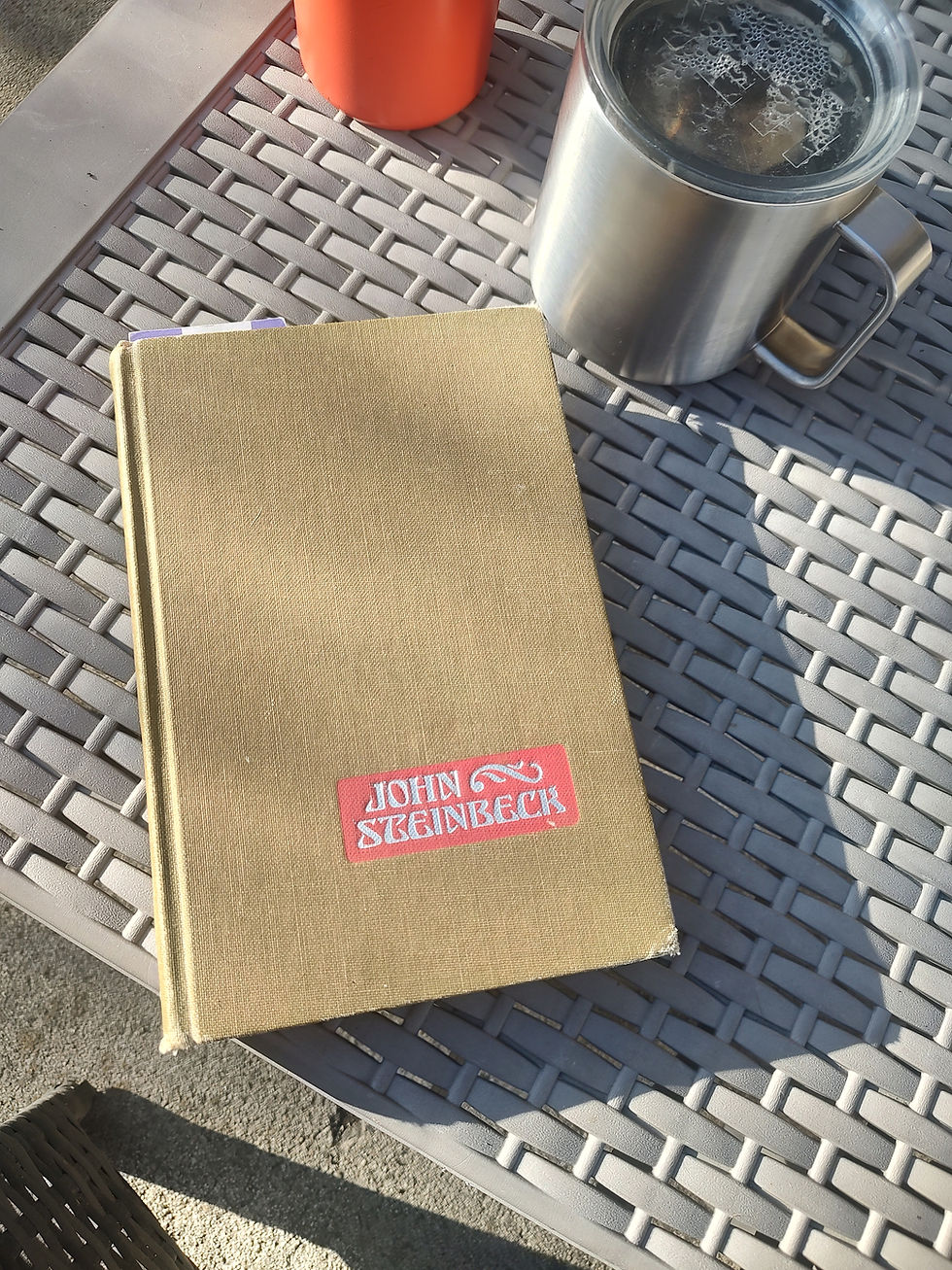
I like to take a peak in the “little libraries” scattered across the neighborhoods I jaunt through on my daily walks.
A couple weeks ago I found a gem.
An old, John Steinbeck. “The Winter of our Discontent.”
I consider myself a pretty big Steinbeck fan, but I hadn't heard of this one. Whether that's a good or bad sign has yet to be determined but, as my wife can confirm, I was pretty tickled to see this in there. Snagged it and began reading it last week. So far, very good!
The personal development book I'm currently reading is, "The Art of Focus," by Dan Koe. I need all the help I can get when it comes to art and focus, so I figured I'd give it a whirl and see if there's anything beneficial to take away. So far it seems like a lot of Dan condescendingly sharing his own philosophical musings. For a young guy (I think he mentions he was 26 at the time he wrote the book?), he seems really annoyed and cynical. Also, early on, he said something about not giving away answers because then he'd be making himself "replaceable." So the book, as he prefaces, is going to basically be a bunch of ideas to try to help you think for yourself and figure out how to focus....artfully? (I am being facetious).
I don't love this Dan Koe guy so far, but I haven't read nearly enough of the book to come to any real conclusions. It's got solid reviews, so I'm going to try to read the entire thing and hopefully pick up some helpful ideas, or at least derive some extra motivation. It's not a very long book so I should be able to read it without much trouble.

Let's move on to the physical culture books.
I've decided I'm going to work my way through the popular bodyweight training books out there.
The first book I read during this little side project, was "Convict Conditioning." This is an extremely popular bodyweight training book, published by Dragon Door and written by the totally fictional (despite their best efforts to convince readers otherwise), Paul "Coach" Wade.

The fictional author and his (also fictional) story of being an inmate in "tough prisons" for 20 years is very cringey. It makes the reading experience difficult to be honest. I guess the "special ops" training schtick drum was beaten and marketed so well that Dragon Door publishing decided to try their luck marketing the hardened, jacked prisoner life. Well, despite my opinion, the schtick worked! "Convict Conditioning" is probably the most popular bodyweight training book in existence.
So let's get to the content.
Believe it or not, the content is worse than the fictional storyline and marketing tactics!
I know. How can that be?! All I can say is, it be's.
The fictional author bases the book around what he determines to be "the big 6 bodyweight exercises for muscle and strength." Awesome! I like where this is headed.
Then he lists his "Big 6."
Alright, I think I have a general idea what they might be, but let's see what he's got, shall we?
1. 1 arm pushup
2. 1 arm pullup
3. Pistol squat
Okay, nothing outrageous so far. I, personally, believe 1 arm pullups are overrated, but I generally understand the idea and the allure of the 1 arm pullup and the strength, control, and effort it takes to achieve.
4. Hanging leg raises
5. Back bridges (not glute bridges, but the flexibility back bend bridge thing)
6. 1 arm handstand pushup
Haha okay, now you've lost me a bit. Nothing – at all – for the posterior chain (no – contrary to this quack author's misguided explanations – pistol squats are NOT a hamstring and glute exercise).
Hanging leg raises are fine. It's a great midsection exercise with some solid grip benefits, as well.
But the 1 arm handstand pushup is comical. "Wade" claims he and a bunch of prison guys are knocking out ridiculous amounts of reps in this exercise. Meanwhile, the most elite gymnasts and calisthenics athletes in the world can't do it. It mechanically doesn't make sense and, according to the elite, proven calisthenics athletes, it's unsafe to try.
The back bend bridge is just goofy and doesn't seem to fit in a book for muscle and strength gain. There are so many great bodyweight exercises, why throw in a flexibility stunt? The only answer I can think is they wanted to provide a balanced general fitness approach (strength, muscle, flexibility, balance, etc). It doesn't seem to belong and most young men looking for a hardcore bodyweight training routine probably would have rather seen an exercise to beef up their arms or legs a bit more. But, that's just my assumption.
Worse, the "steps" to achieving these 6 exercises is even more goofy.
Again, I don't have a problem with the first 4 exercises in the list. But the prerequisite exercises to the goal exercises are foolish.
"Coach," mentions actually good supplemental exercises – like decline pushups, deficit pushups, and varied grip pushups – but says they're not very good because they're not as useful for the "goal exercise" as some other, totally irrelevant exercises (like half pushups – working just the top half of the exercise, stopping when your chest hits a basketball).
It's not just the pushups that have these weird, low quality "step" exercises. All the "steps" to the "goal/prison standard" exercises are weird. Instead of recommending box step ups, lunges, Bulgarian splits squats, and standard split squats as progressions and quality leg strengthening while building up to doing pistol squats, he puts those as optional supplemental exercises, which he deems as not very good exercises. Haha, okay "Paul Wade."
Next, Paul's knowledge on biomechanics and anatomy is horrendous.
You don't have to be an anatomy geek to write a book on exercise. But if it's not your strong suit, don't spend so much time trying to explain anatomy. I've been a personal trainer since 2015, and, while I understand anatomy pretty well, I almost never feel it necessary to try to provide an anatomy class. Paul Wade tries to provide a class on the topic of anatomy – a topic he has a very poor grip on – several times throughout the book. The only reason someone tries to do that is if they're trying to prove themselves to be an expert. It also contradicts his entire "school of hard knocks" wisdom schtick (there's a lot of weird schticks going on in the "Convict Conditioning" brand). It's just weird.
Worst of all, Paul Wade commands you – no matter how advanced you are before starting his training plans – to begin with the very first step and staying with that step for 4 weeks! He then has you progress through all 10 steps, sticking at each step for at least 4 weeks (longer if it takes longer to hit the set and rep goals for that exercise "step," which means variation in this book).
That means when doing pushups, you must begin with sissy standing wall pushups (not the name he gives, but the name I provide for the exercise where you face the wall and push away from the wall – an incredibly low level exercise, especially considering the goal of the book is to do a single arm pushup with your feet together, which is a very advanced variation).
I always hate this. Why would someone that can do full pushups with good form, intentionally detrain themselves for 20 weeks before getting back to regular pushups to finally start trying to progress? Programs that demand such nonsense are created by totally delusional egotistic dorks. This recommendation alone – and the ridiculous number of pages he uses to explain and justify this idea – is enough reason to NOT read "Convict Conditioning."
The program designs at the very end aren't totally awful. They could be quite good if you increase the volume OR frequency, while selecting you're own preferred bodyweight exercise variations.
They're low volume and very minimalist, which is fine, but, Wade recommends low frequency as well. So the programs end up usually being 2 sets of 2-3 different exercises 2-3 days per week. Each exercise is only being trained once per week. Since the exercises don't have crossover across muscle groups (except handstand pushup variations and pushup variations), each muscle is trained for just 2 sets per week.
I'm a fan of low volume, but I don't think low volume and low frequency are a good combination. I've always promoted the benefits of low volume if and when combined with high frequency. I think you'd be better off training almost daily (4-6 days per week). This would certainly expedite your gains and would make the programs pretty decent.
Anyway, I'm shocked this book is so popular. Upon further inspection, though, it seems like most serious bodyweight trainees have similar or even more aggressively negative opinions about this book and "Paul Wade."
Staying true to the mission, and because I'm a miserable son of a gun, my next book is fictional Paul Wade's second book, "Convict Conditioning 2." I've got to give it an honest shot, independent of what I thought about the first book. This second one covers some different goals and body parts, and was written a few years later so maybe the people behind this fictional author will have a better product to offer. I'll keep you posted on the next Lift & Read Book Club issue.


Comments